Welcome!
My name is Blaine, I am a graduate student at the University of Kentucky and a researcher at the Sanders-Brown Center on Aging. My work focuses on awake intravital fluorescence microscopy, mouse models of dementia, astrocyte calcium signaling, vascular dynamics, and the development of computational tools for extracting biological meaning from complex imaging datasets.
I've built this site to showcase some of my academic accomplishments and as a repository to share my experimental methods and tools used to conduct my research. My goal is to build and make available useful analysis systems that make difficult brain imaging experiments more quantitative, reproducible, and visually interpretable.
Research Focus
My research centers on understanding how cellular activity and cerebrovascular dynamics interact in the living brain, particularly in the context of dementia and Alzheimer’s disease-related pathology.
Using awake intravital microscopy, I study activity patterns across astrocyte somata, processes, and perivascular endfeet while simultaneously examining vascular responses such as dilation and constriction. These datasets are rich, dynamic, and difficult to analyze with conventional tools, which led me to build custom software for event detection, segmentation, synchronization analysis, and vascular-cell coupling.
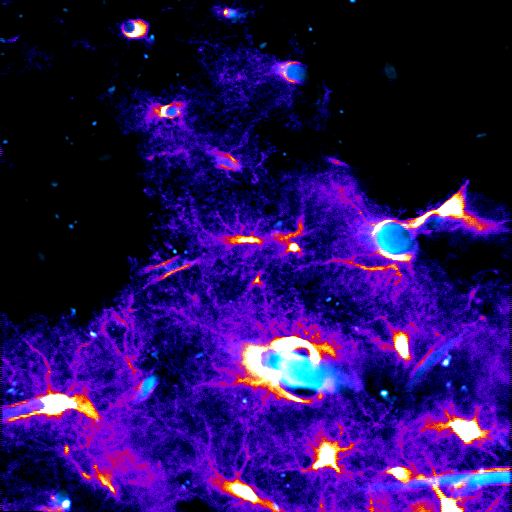
STONE-LAVA
A computational framework for spatial and temporal analysis of brain activity, vascular behavior, and multimodal fluorescence imaging datasets.
STONE
Spatial & Temporal Observation of Network Events
STONE is designed for functional imaging analysis of cellular activity. It includes tools for activity-based cell detection, filtering, event detection, waveform extraction, and network-level synchrony analysis.
- Activity-informed ROI detection
- Subcellular signal extraction
- Calcium event detection
- Network synchrony and correlation analysis
- Export workflows for reproducible downstream analysis
LAVA
Localized Analysis of Vascular Astrocytes
LAVA was developed to compare stimulation-induced vascular motion with local perivascular cellular signaling. It was named for its original use case: measuring astrocyte endfoot activity around cerebral arterioles.
- Vessel-associated ROI analysis
- Perivascular astrocyte/endfoot signal quantification
- Dilation and constriction tracking
- Event-locked vascular-cell comparisons
- Multimodal image/signal integration
Research Themes
Awake Intravital Microscopy
Imaging brain activity in awake mouse models to capture cellular and vascular dynamics under more physiologically relevant conditions.
Astrocyte-Vascular Coupling
Quantifying how astrocyte compartments, especially perivascular endfeet, relate to nearby arteriole motion and stimulation-induced vascular responses.
Dementia Models
Applying advanced imaging and analysis tools to mouse models relevant to Alzheimer’s disease and neurodegenerative pathology.
Functional Signal Analysis
Developing pipelines for fluorescence signal processing, event detection, filtering, synchronization, and network-level activity mapping.
Software Development
Building MATLAB-based tools that streamline complex imaging analyses and improve reproducibility across experiments.
Data Visualization
Creating visual and quantitative summaries of cellular activity, vascular motion, network structure, and compartment-specific signaling.